The science stays. The stack moves.
Geoscience software for foundation GEOINT, safety of navigation, and geomatics, at speed, scale, and precision, from the enterprise cloud to the disconnected edge.
Decades of code. One AI deadline.
Your production workflows still run on scientific code written before the web, on hardware nobody sells anymore. The science inside it is right and irreplaceable. Now the AI pipelines need that output as AI-ready data, on one authoritative geospatial foundation, delivered across security fabrics to analysts at the point of mission need, including sites with austere networking. Rewriting from scratch risks the science. Standing still risks the mission.
Modernize the code. Keep the twelfth decimal.
We build and modernize the geoscience software behind geospatial production: the numerical models and production code that turn measurements into foundation GEOINT, safety-of-navigation products, and the hydrographic science of geomatics. We modernize without changing what it computes, and we deliver the result wherever the analyst is. Identity comes with it: who may see which data, down to the cell, is brokered from your enterprise provider into every map and catalog we build.
225 modules at a 100% pass rate
Legacy scientific modules refactored for a global intelligence enterprise with no rework and zero production errors, delivered 30 days early and under budget.
Outcomes, measured.
Open standards, on your stack.
Fortran (77 to modern) · C++ · Java · Python · PostgreSQL and PostGIS · AWS ParallelCluster HPC · Docker and Kubernetes · GitLab, Jenkins, SonarQube · Esri and ArcGIS · OpenLayers · Cesium · MapLarge · OGC web services · STAC · NiFi, Kafka, Accumulo · Keycloak · Kong · ELK · ICEYE SAR · NAIP, Sentinel-2, 3DEP imagery · SAM and U-Net · vision-language models · Overture GERS
Discover first. Then move the science.
Every geospatial engagement runs on Start. Ship. Strengthen. It opens with a 30-day structured discovery of the undocumented legacy system, because nobody has the design document and somebody has to read the code. Then we retire the oldest layer first, keep the familiar interface, move the data model underneath, and change the interface last, so users adopt on their schedule and the production line never stops. A gold branch controls every release, regression to the twelfth decimal runs before anything ships, and SAFe release trains carry work through DevOps into operations and sustainment. Where AI helps with code analysis, refactoring, documentation, and schema redesign, a human reviews every change.
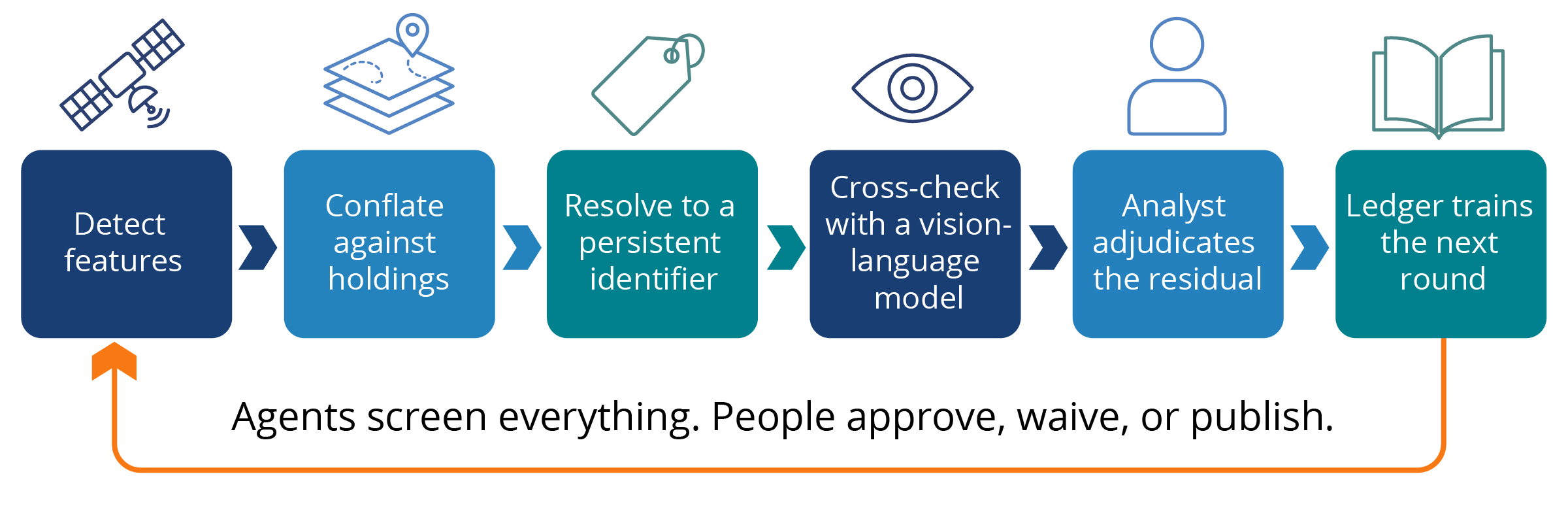
Feature extraction, with the analyst in the loop.
On open data, the champion model in the feature-extraction pipeline we designed and built scored 0.790 correctness and 0.812 completeness against a 0.780 inter-reference ceiling, resolved 87% of features to persistent entity identifiers, and produced a 133 KB edge feed from 151 MB of imagery. Every promotion passes a champion gate. Every feature an analyst rejects trains the next round.