Start where you are. Ship on a cadence. Strengthen every release.
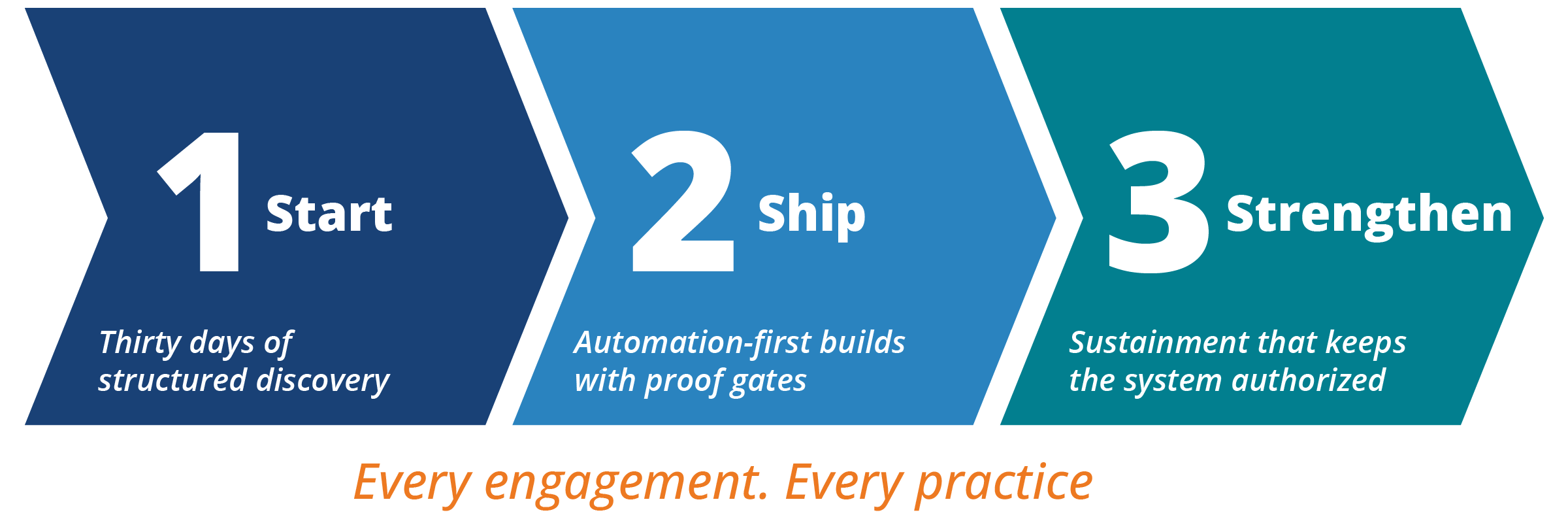
Three steps, every engagement. We call it Start. Ship. Strengthen.
Whatever your mission, you already have a culture, a stack, and a process that keep it running. We start there. Every engagement, in every practice, follows three steps: understand and stabilize what you have, automate and secure what you build, then field and sustain it with results you can measure.
Develop with purpose. Maintain mission focus. Implement realistically.
Those three lines have been our stance since our first engagement. Start. Ship. Strengthen. is what they look like in practice: one method shared by all three practices, so you get the same discovery, the same pipeline discipline, and the same hardening and measured improvement after go-live whichever door you came in.
Start: understand and stabilize.
Thirty days to know what you have, including the parts nobody documented.
We begin with a structured discovery of the systems you rely on today: the data, the dependencies, the workflows, and the dead code. We map them, retire what nothing uses, and agree with you on what “done” looks like before we build. Mission continuity comes first. Nothing you depend on stops working while we modernize it, and adoption moves at your users’ pace.
- 30-day structured discovery of undocumented legacy systems
- Rapid legacy analysis to retire dead code before refactoring
- A jointly built quality plan with monthly performance reviews against it
Ship: automate and secure.
Automation goes in before the first release, so every release after is repeatable.
We build the pipeline first, then the feature. Infrastructure as code, containers, and continuous integration and delivery are in place before the first deployment, and security rides inside that pipeline rather than behind it: static and dynamic analysis, container scanning, software bills of materials, and hardened base images, under continuous authorization to operate practices aligned to ICD-503 and the Risk Management Framework. Nothing merges without independent review, and every finding is written down and dispositioned.
- DevSecOps factory with security gates that alert on threshold breach
- Continuous ATO: plan-of-action tracking, continuous monitoring, evidence on demand
- Adversarial cross-model review before release, with every finding dispositioned in an append-only log
- Proof gates in CI, so a release proves it works before a person signs it
Strengthen: field, harden, improve.
Across the air gap, into operations, and still improving after go-live.
We carry systems from connected development across the air gap into our customers’ most secure enclaves, with offline mirrors so the pipeline works where the internet does not. Then we make it stronger. Corrective, adaptive, preventive, and perfective maintenance run in one backlog, ranked by mission effect, so the system improves on the same cadence that keeps it up. Sustainment is designed to free budget, not hold it: when automation absorbs growth, the money that would have bought more operators buys the next capability. Governed AI augmentation runs across every tier, from the help-desk ticket to the refactor, with a person approving each change.
- Air-gapped promotion into secure enclaves and government clouds
- SAFe release trains at multi-team scale
- ITIL sustainment with 24×7 Tier 2 and perfective maintenance
- Section 508 and WCAG 2.1 assessments, with a VPAT, on every delivered interface
Measured, not promised.
Outcomes from engagements that ran this way.
Under 1 hr
Code to production: from more than 35 hours to under one hour
Over 90%
Infrastructure as code coverage: from 35% to more than 90% in seven months
Zero
Zero ATO-impacting findings across four consecutive security assessments
9
Nine releases in 16 months into air-gapped enclaves
Elsewhere, test execution time fell by 78 to 94 percent while coverage rose 23 to 37 percent, and security remediation moved from weeks to days.
Open interfaces. No lock-in.
We build on the platforms your enterprise has already chosen and connect them through open standards: OIDC, SAML, and SCIM for identity; CAEP and Shared Signals for response; OGC services and STAC for geospatial data; Open Policy Agent for policy. We prefer open source where it is the best-enabling option, and everything we build for a program is delivered so you can hand it to the next contractor without asking us: source, pipelines, documentation, and the evidence that authorized it. That is implementation realism: a system you own is a system you can keep.
Machine speed. Human judgment.
Automation and AI make our delivery faster. They do not make the decisions. In every pipeline we build, an accountable person approves, waives, or publishes; agents and models propose, screen, and draft. That is a design rule, not a preference, and it is how we bring AI into environments where consequences are real.
Delivered by the people you met at kickoff.
Bana fields engineering teams with decades of experience supporting intelligence and Department of War missions in support of national security. We self-perform in our customers’ most secure enclaves, air-gapped environments, and government clouds. We do not have a bigger portfolio to move your best engineers to. The team that starts a program is the team that runs it, and program transitions are where our people stay.
Trusted. Certified. Self-performed.
- Engineering teams with decades of experience supporting intelligence and Department of War missions in support of national security
- Delivery inside our customers’ most secure enclaves, air-gapped, and disconnected environments
- Self-performed by the team you meet at kickoff
- CMMI Level 3 for Development and Services
- ISO 9001:2015
- CMMC Level 2 self-assessment complete; C3PAO assessment in progress